

PinchukArtCentre: NEWS
STILL JOY – FROM UKRAINE INTO THE WORLD @ BIENNALE ARTE 2026. A Collateral Event at the 61st International Art Exhibition — La Biennale di Venezia. Presented by the Victor Pinchuk Foundation and the PinchukArtCentre
On 7 May 2026, the Victor Pinchuk Foundation and the PinchukArtCentre opened the project “Still Joy — From Ukraine Into the World” which is an official Collateral Event of the 61st International Art Exhibition — La Biennale di Venezia. During the opening ceremony, speeches were delivered by Victor Pinchuk, businessman and philanthropist, founder of the PinchukArtCentre; Tetyana Berezhna, Deputy Prime Minister for Humanitarian Policy of Ukraine and Minister of Culture of Ukraine; the exhibition’s curators Björn Geldhof, Artistic Director of the PinchukArtCentre, and Oleksandra Pogrebnyak. Hlib Stryzhko, a veteran and marine who returned from Russian captivity, and Yuliia “Phobia” a senior sergeant in the Armed Forces of Ukraine, marine and combat medic, also addressed the audience.
During the exhibition’s opening ceremony, Victor Pinchuk, speaking about Ukraine’s resilience during the war and the importance of art in difficult times, noted: “I think many people in the world now need to feel the power of joy. Because so many Ukrainians can share the experience and the understanding of joy. And Ukraine is very generous in this sharing. And I think art can help you with this sharing and help to understand joy in the difficult moments of your life. You have to understand: you must support Ukraine for your own interest. And I believe that the majority of people in this room understand this.”
At the same time, he criticized the decision of the Board of Directors of La Biennale di Venezia to allow Russia to reopen its national pavilion: “Our terrible, crazy enemy was banned from participation in the Biennale in 2022 and then in 2024. And since then, has Russia become better? Let’s think about this together. Since 2022, they have destroyed many dozens of Ukrainian museums, Ukrainian libraries. They have killed hundreds of Ukrainian artists. They have killed hundreds of thousands of Ukrainians. And what did the leadership of the Biennale decide? To let them back to Venice. It’s a terrible, ugly, unacceptable decision.”
Tetyana Berezhna emphasized the resilience of Ukrainians: «Sometimes it’s strange to think about that, but in Ukraine we no longer postpone or delay anything. We know that we have to act here today because tomorrow may never happen. Sometimes we joke that Ukrainians have very flexible work hours. If you wake up alive, you go to work; if you don’t, you do not. So this is the reality that we are living now in Ukraine. But still we have inspiration, power and energy to create.
As the Minister of Culture, I’m really grateful for this exhibition and this event because thanks to it our guests will know more about Ukraine and the beautiful people that are living in Ukraine. I like the expression that Ukrainians are ordinary people who create extraordinary things. And this is absolutely right».
The exhibition’s co‑curators, Björn Geldhof and Oleksandra Pogrebnyak, speaking about the creation of the exhibition, noted: “It started with stories of joy. Stories of joy express our profound will to live and to defend our freedom. They also help us come together and imagine the future. The first question we had was, “How can we speak about joy?” Because it is quite counterintuitive to speak about joy in a time of war. Luckily, we didn’t have to do this alone. And when we began to think about it, we realised we were not the ones to define joy. We asked our heroes.”
Hlib Stryzhko, whose testimonies became the starting point and driving force of the project, says: "I love life very much, and I think life loves me too. I was able to see that for myself back in Mariupol.” After recounting his injury and time in captivity, Hlib finally expressed an extremely important point: “And today I am here to remind you that the strength of Ukrainians is the ability to find joy every day, despite everything. So whenever you see a Ukrainian man or woman being happy and smiling, you can be sure that they are happy and they are invincible”.
Yuliia “Phobia” whose path to the war began back in 2014, was inspired by the first safe dawn in all that time and noted: “The war doesn’t leave much time for saying nice words. It breaks our sense of context. It disrupts all logic and rationality. And it makes us search for meaning where it is not supposed to be. But there is still something the war has not managed to destroy. It is the bond between people. It is what brings us together. And it is not an abstract concept — it is the force that lifts you up when you are completely exhausted. We lift up those who are falling. We support those who are breaking down. And it is true to say that our strength and our power lie in our unity. When we speak about joy, it may seem inappropriate in the context of war. Perhaps that is true, but joy is proof that we are still alive and fighting.”
About the exhibition «Still Joy — From Ukraine into the World»
Still Joy — From Ukraine into the World brings together leading international and Ukrainian artists reflecting on the concept of joy as both a vital force and a radical act of humanity. The exhibition’s starting point and disruptive agent are the testimonies collected by the Ukrainian story-gatherer Hlib Stryzhko, a marine, veteran, and former prisoner of war. These stories are anchoring fragments of reality within the exhibition.
Participating artists include: Kateryna Aliinyk (UKR), Piotr Armianovski (UKR), Janet Cardiff & George Bures Miller (CAN), Julian Charrière (CH), Tacita Dean (UK), Ryan Gander (UK), Gabrielle Goliath (SA), Nikita Kadan (UKR), Zhanna Kadyrova (UKR), Alevtina Kakhidze (UKR), Roman Khimei & Yarema Malashchuk (UKR), Pavlo Kovach (UKR), Bogdana Kosmina (UKR), Katya Lesiv (UKR), Kateryna Lysovenko (UKR), Simone Post, (NLD) Ashfika Rahman (Bangladesh), Daniel Turner (USA), Álvaro Urbano (ESP), Lesia Vasylchenko (UKR), Oleksiy Sai & Yury Gruzinov (UKR).
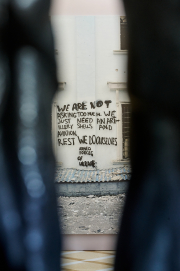
The exhibition begins with a video installation of rave scenes in Kyiv, captured before and during the full-scale war, by prominent Ukrainian artist duo Malashchuk & Khimei. Nearby are Aliinyk’s landscape paintings, where small animal life vibrates under a soft moonlit glow, and a video essay by Armianovski, blending the reality of war and discovering dreams seen by the Ukrainian city of Mariupol. The first section culminates in a new site-specific, immersive installation by Simone Post, reimagining the palazzo’s interior through an ephemeral architectural structure made of candy, inviting visitors into a moment of childlike joy.
The exhibition continues with individual stories, memories of lost communities, and contemplations of love. Future Generation Art Prize winners Ashfika Rahman (Main Prize, 2024) and Zhanna Kadyrova (Special Prize, 2014) address forced displacement through endurance, care, and responsibility in their unique works; Rahman’s radiant installation of Hindu temple bells suspended by golden silk threads appears in conversation with plants salvaged from bombed Ukrainian buildings: Kadyrova’s site-specific installation composed of light boxes and living plants — figures of “refugees” in transit, receiving healing and care.
Personal joys - at once empowering and sorrowful — emerge in Gabrielle Goliath’s recent video works depicting Ukrainian LGBTQIA+ soldiers and civilians, sharing intimate testimonies. Joy as memory and love runs through Tacita Dean’s 39-minute 16mm film, If I were in the Adlon (2025), featuring the Ukrainian artist Boris Mikhailov and Vita Mikhailov, his wife, collaborator and muse, during one afternoon in the eponymous Berlin hotel, known for its ties to Cold War intrigue and espionage. Nearby, Cardiff & Miller’s installation Conversations with My Mother (2023), where telephones become a thread that binds us to those who are no longer here.
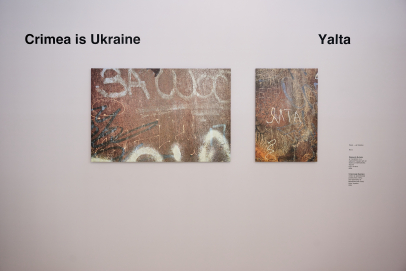
Moving through landscape and body, further works by Dean, Kakhidze, Urbano, Sai, Gander, Charrière, and Kadan trace how human actions leave marks and scars. From Dean’s hand-touched photographs of century-old Sakura trees to Urbano’s painted-metal Kalyna (viburnum) branch — a plant no longer meant to be smelled or plucked — the works call into relief the simple but precarious joy of survival. Kakhidze’s accompanying in-exhibition tattoo salon allows viewers to themselves be literally marked by the exhibition, in perpetuity. The exhibition concludes with a monumental drawing depicting a historical scene of a silent rave, captured by leading Ukrainian artist Nikita Kadan, where bodies become a landscape of emergence and loss.
Across all its layers, Still Joy responds to the present moment — originating in Ukraine and extending beyond — to a place that is fragile, yet resilient, where joy endures.