

Press about us
Russia seeks to derail Ukraine’s trade deal with E.U., deploying taunts and insults
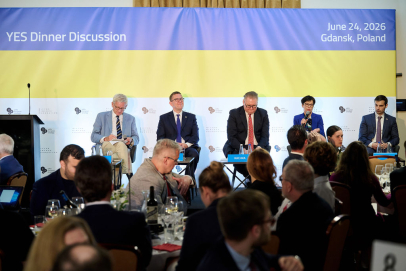
YALTA, Ukraine — When Hillary Rodham Clinton gave a shout-out to Ukrainian chocolate, it was clear the battle had been joined.
Russia wants Ukraine firmly in its camp, but time is running out. To gain the predominant say over its neighbor’s destiny, Moscow has been furiously trying to derail a pending trade agreement between Ukraine and the European Union. Russian President Vladimir Putin’s government has been deploying insults, dire warnings and customs delays in its efforts to sway the decision.
And, for a while, it refused to import chocolates from Ukraine’s premier confectionery company after Russia’s usually pliant health inspectors suddenly discovered heretofore undetected sanitary shortcomings in the candy boxes.
Russia’s tactics in a struggle that pits East vs. West are “totally stupid and counterproductive,” said Viktor Pinchuk, one of Ukraine’s wealthiest men and the host of an international conference here that ended Saturday, after Clinton and a parade of American and European leaders urged Ukraine to finalize the deal with the E.U.
Putin wants Ukraine to join the customs union of Russia, Belarus and Kazakhstan instead, but his strategy has been all vinegar and no honey. The Ukrainian prime minister, Mykola Azarov, called Russia’s demands an attempt at “humiliation.”
And yet, as much as Putin seems to be pushing Ukraine into Europe’s embrace, ambivalence here runs deep. Azarov and Ukrainian President Viktor Yanukovych have said they intend to sign with the E.U. in November, but they have a way of hedging every statement.
It’s a momentous choice. Ukraine has the chance to opt for a road that in theory would extend European values of transparency and the rule of law far to the east. Or it can join Russia in a financial and cultural zone that is increasingly defining itself as separate from the West and not answerable to Western norms. As a nation of 46 million, Ukraine would be a significant addition to Putin’s Eurasian Union.
If Ukraine is to sign what is called an association agreement with the E.U., dismantling most trade barriers, it will have to pursue far-reaching legal reforms and renounce the sort of “selective justice” that has landed former prime minister Yulia Tymoshenko and other political opponents of the current government in prison.
Yanukovych said Friday that he wants to release her, as Europe demands, but just can’t seem to find the legal means to do so. His opponents charge that he’s also reluctant to tackle the country’s endemic corruption.
“Total corruption has eaten the country today,” said Vitali Klitschko, a boxing champion who heads the UDAR opposition party. Signing the association agreement is a vital step toward rooting it out, he said.
If Yanukovych fails to meet the E.U.’s terms and the agreement falls through, Klitschko asked the president to his face, “Will you have the guts to resign?”
Russia’s abrasive tactics
There’s another factor. Ukraine’s trade volumes with Russia and with the E.U. are about the same, even without the chocolate, which means there are powerful interests here in favor of Moscow, in sectors that might be hurt if the country is opened up to European competitors. oining Russia could mean instant relief on the price of natural gas, much of which is imported from Russia. Siding with the E.U. could have long-term benefits, but, Azarov said, the immediate effect would be negative, as Ukraine struggles to implement reforms and deal with Russian trade sanctions.
“It isn’t all roses,” he said. “There are thorns, as well.”
But the Russians seem to be even spikier. Sergei Glazyev, who is Putin’s assistant in charge of enlisting Ukraine, showed up here Saturday and threatened Ukraine with even more sanitary-inspection problems if it joins Europe, as well as new trade barriers and no hopes for an easing of gas prices.
He said the hit to Ukraine’s economy from the loss of the Russian market would be in the billions of dollars. He questioned whether the E.U., which is dealing with its own less-than-robust economy, is prepared to take on the huge burden that he said Ukraine would inevitably become.
For good measure, he freely insulted a fellow panelist and questioners from the audience, and cracked a joke about Ukrainian chocolate.
His pugnacious manner was either intended to sow doubts within the E.U. about whether this is a fight worth pursuing, or just emotional acting out.
“It demonstrates weakness,” Lithuanian President Dalia Grybauskaite said of Russia’s tactics.
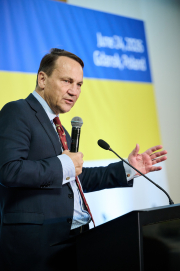
“No one has the right to bully others,” said the Polish foreign minister, Radoslaw Sikorski.
As for chocolate, Clinton called it “excellent” and noted that it “can be exported to anywhere in the world with the proper effort.”
Hopes and promises
Europeans worry that Yanukovych will bet on them ultimately being flexible on releasing Tymoshenko and on other changes to the legal system, so eager are they presumed to be to usher Ukraine away from Russia. Not so, they insisted.
“There’s no way the European Union can lower the bar when we’re talking about values and principles,” said Stefan Füle, the E.U. commissioner for enlargement and European neighborhood policy.
“The risk of miscalculating,” Sikorski said, “is just too big for you to take.”
“The rule of law matters to your economy, to your society, to your sense of self-worth,” said Tony Blair, the former British prime minister.
On Wednesday, the Ukrainian parliament formally signed off on the agreement, after passing a series of laws. That bipartisanship in this politically riven country was made possible by Russia’s punitive approach to persuasion. Now the issue, from the E.U.’s point of view, will be whether Ukraine has a plausible plan for actually implementing those laws.
Poland’s former president, Aleksander Kwasniewski, said Ukrainians shouldn’t be afraid of siding with Europe, citing the benefits that came to his country after it did so. The agreement could lead to eventual E.U. membership, he said. Plus, he added, Poles learned the hard way that standing up to Russia is the best way to get Moscow’s respect.
And, Sikorski solemnly said, if Ukraine comes on board, “I undertake to eat more Ukrainian chocolate.”