

Press about us
Ukraine, the Theater, and Their Echoes
It has already been a year.
It has been a year, almost to the day, since the revolution in Ukraine overthrew the corrupt, tyrannical, and, in its last days, murderous regime of Viktor Yanukovych.
To mark the anniversary of that event, which I followed closely from its beginning, and to which I endeavored to contribute by coming twice to speak in the Maidan, and which, to this day -- that is, up through my visit earlier this month to the city of Kramatorsk in the Donetsk region, in the combat zone -- has filled me with an unwaning enthusiasm, President Petro Poroshenko invited me to the Kiev National Opera to perform my play, Hôtel Europe, in which Jacques Weber starred last fall at the Théâtre de l'Atelier in Paris.
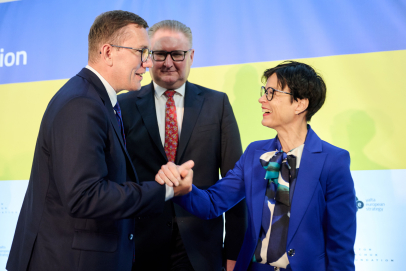
In the audience were intellectuals from Kiev and veterans from Luhansk; heads of state who, the next day, would participate in the Dignity March that Poroshenko modeled on the Jan. 11 march held in Paris in honor of the victims of the shootings atCharlie Hebdo and the kosher market; and Harlem Désir, an old comrade of mine and now France's minister of European affairs who, by his presence in the audience, reminded us that France considers Ukraine part of Europe.
Regina and Vlad Davidzon were there from the review La Règle du Jeu. Hand in hand with the Victor Pinchuk Foundation, they managed to stage a performance that, in a time of peace, would have required weeks to put together.
As for me, in the manner of Meyerhold, who, in Moscow in 1917, would rewrite his plays nearly every night to include what he called "the news from the front," I spent the preceding days and nights adapting my text to the latest developments in the current situation in Ukraine.
The plot remains the same, of course.
It is the same story of a writer who has two hours to prepare a major speech on the future of Europe and who, mysteriously, cannot seem to do it.
The scene of the action is still the martyred Bosnia for which I fought passionately, to which the character has returned, like the Musketeers, 20 years after the fact.
A line, sometimes no more than a word, suffices to make Debaltsevo echo Sarajevo.
An inflection, a minuscule modification, a phrase, is enough for the Minsk accords signed recently by Ukraine and Russia to suggest a sequel to Dayton.
And when my writer character mentions Bosnia's Alija Izetbegovic, when he praises the man of culture who became a valiant war leader, when he glorifies the magnificent pessimism of the civilian who made war reluctantly and won, there is no need to change a word for the audience to hear Poroshenko's name and erupt into applause.
There was more emotion when Lisbon's flaming Avenida Palace -- where, 40 years ago, I saw General Otelo de Carvalho suffocating in billows of smoke -- becomes the fifth floor of the torched union headquarters on the Maidan, with the backlit silhouette of Evgeni Nitchuk visible in the night.
And when, in one of the text messages that never stop interrupting the struggling writer by bringing him news, not only from the front but from the wider world (messages that the audience sees projected on the wall at the back of the stage), there appears the sports headline of the day: "Vitali Klitschko the winner over Arthur Cravan in Kiev" -- the victorious revolution, for once, of the most mysterious, the most demanding, of literary forms.
And when -- on the subject of the arms that will have to be supplied to bring some balance, as was true in Bosnia, to the opposing forces and thereby create some chance of ending the war -- my character seeks, as the vehicle for the delivery of arms, the equivalent of the individual to whom I referred in the original text as "our Turkish friend" and comes out with the name Nadiya Savchenko, the pilot captured in Donetsk who has become, since being imprisoned by Putin, a sort of Ukrainian Joan of Arc.
Is it possible that universal history has available to it a limited number of great scenes that it never stops repeating, as in the theater?
Does it embellish endlessly the same simple themes, the awful secret of which I have not been able to divine in 40 years of war reporting?
Is it I dreaming, or is it history? Is it my family heritage playing tricks on me or the phantoms of the dark ages, those phantoms that sleep with one eye open, when, from Bosnia to Libya, from Afghanistan to Kurdistan, or today in Kiev, I keep hearing replays of Spain and the French Resistance?
I will probably never know.
The only thing I can say is that when the curtain fell on the last line of the play -- "Glory to Ukraine! Glory to Europe!" -- which I endeavor to shout out in the language of Vasyl Stus and Lesya Ukrainka, and when Petro Poroshenko took the stage to express his friendship and, in Churchillian tones, rally his countrymen to the endurance and valiance required by the torrent of blood and tears that has been unleashed on them, I did not know what was uppermost in my mind: the intense joy of participating in a sorrowful but noble commemoration, or the sadness that, in the manner of the Sages, clings to the messianic obviousness of the incompleteness of all things.