

Press about us
Former chancellor argues for a closer relationship with Moscow at the Yalta conference – in the Ukraine this does not go down well
Schroeder's Russian speech
Former chancellor argues for a closer relationship with Moscow at the Yalta conference - in the Ukraine this does not go down well
By Frank Nienhuysen
Yalta - there are hardly any prettier places in the Ukraine to talk about the country's future in Europe and even Gerhard Schröder could not miss this. Today the White Hall in the Livadija Palace in Yalta is as dazzling as the sun that is shining through the elegant windows into the room inside. The ceiling of the old residence of the Tsar is covered with ornaments and the walls are maintained in the style of the Italian renaissance. In the next door room in Schröder's view, the large round wooden table where Stalin, Churchill and Roosevelt established the post-war world order in February 1945 in the Crimea.
But the former German chancellor is not at all in the mood for nostalgic memories - other than greeting "a good old friend", as he put it, in the front row, namely Victor Tchernomyrdin, formerly CEO of Gazprom and Russian prime minister, now Moscow's ambassador in the Ukraine. But the chancellor assumes his role at this Yalta conference. He takes just 3 minutes to dismiss Ukraine's attempts to join Europe. He does this professionally saying that Germany has had a close relationship with the Ukraine for many years and that it has supported the reform process from the outset. But that is all he says. Because he now changes the subject of the conference and talks so passionately about Russia that even Victor Tchernomyrdin sitting expectantly in the front row could not have done better.
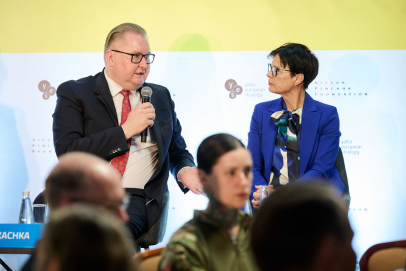
Schroeder says of-course the European policy towards neighbouring countries must be expanded, but "it is also important to strengthen our partnership with Russia". Russia, so he says, has been a reliable energy partner; "I understand certainly that there is a debate about the dependence on Russia. But this is totally wrong. The question is: who can guarantee gas and oil supplies? What is the alternative? Central Asia needs time. So are we thinking of Nigeria?, Iraq?, or Algeria? Of-course it's Russia". And Moscow has alternatives, it could focus on China more, he says: Europe on the other hand has no alternatives. Schröder mentions the name of Russia in almost every sentence, meanwhile the Ukrainian foreign minister Arsenij Yatsunek sits on the podium with no expression on his face hoping that the name of his country will finally be mentioned again. Poland's former president, Alexander Kvasknievski looks clearly bored and fans himself cool air with his hand.
Schroeder, who is the chairman of the supervisory board of the operating firm for the construction of the East Sea pipeline adds a couple of new comments on behalf of Russia: "Europe needs the Blue Stream Pipeline. And Europe needs the South Stream". Both projects would ensure Russia the largest gas reserves in central Asia based on access, while significantly weakening the Nabucco project which is supported by the European Union, because this pipeline would bypass Russia. Later Schröder tells the Süddeutsche Zeitung: "Of-course this does not mean that I am against Nabucco. In fact we cannot get enough pipelines."
From Schröder's point of view his appearance has been a huge success. He emphasized Russia's role for Europe and he managed to stoke considerable discussion about his speech in the hall of the Tsar's palace covered in flowers. Marec Sivic, Polish vice president of the European Parliament, asks the CDU member of parliament Karl-Georg Wellmann: "Do all of you in Germany think like Schröder?" A few Ukrainian members of parliament mumble because, although he is not at all a fan of their desire to join Europe, they do not want to openly criticise him. Member of parliament Dmytro Vydrin exclaims: "It was clear that he would support Russia, I find this totally normal".
To the relief of many Poles, Ukrainians and people from the Baltic countries, Schröder is no longer chancellor of Germany, but his words still carry weight. Kwasnievsky is very well aware of this. When Schröder suggests that the Ukraine could turn into a bridge between Russia and Europe, the Pole answers coolly: "Russia does not need any bridge. The EU must see the Ukraine as an independent state and not as an object of the relationship between Russia and the EU." The German CDU member of parliament Manfred Grund says "Schröder is not doing the Ukraine any favours with the bridge suggestion. In fact he could have made his speech in Russian."