

Press about us
Plugging into the age of uncertainty
For most of the past century, the big global narrative has been the clash of rival paradigms: Nazism versus liberal democracy, communism versus free market democracy, and, more recently, fundamentalist Islamic states versus the secular, democratic west. When the cold war ended, Francis Fukuyama predicted that this clash of paradigms would end. He was right, but not for the reason he thought.
The battle of rival ideologies has ended not because, as Fukuyama foresaw, the triumph of capitalist democracy has been universally acclaimed. Instead, it is because all of us have realized we face a new challenge — how to thrive in the high tech, global economy — and no one country or single ideology is yet certain of getting this exactly right.
This isn’t the cold war, or the clash of civilizations, or even the end of history — it is the age of uncertainty, as the entire world struggles to understand and keep up with the biggest economic transformation since the industrial revolution.
I was persuaded that this single, uncertain global effort to keep pace is our new overarching challenge at a venue which was the setting for one of the seminal decisions in the age of rival paradigms: the Livadia Palace, in Yalta. In this cream colored villa a comfortable lawn’s distance away from a rocky cliff that drops to the Black Sea, Churchill, Roosevelt and Stalin made their infamous pact to divide Europe between the communist east and the democratic west.
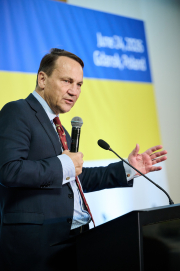
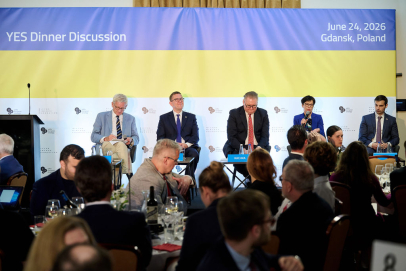
Today, Yalta is again at the crossroads of democracy and authoritarianism as Ukraine, the country to which it now belongs, wavers between integration with Europe and integration with Russia. But when I spent two days there early this month moderating a conference on geopolitics, the most important takeaway was that this old dilemma was the wrong one for Ukraine — and everyone else — to focus on.
The most articulate expression of the new paradigm came from Carl Bildt, the former Swedish Prime Minister, who was re-appointed foreign minister last month after the election victory of his centre-right party.
“The megatrend of our age is globalization,” Bildt said. “That process of globalization has shown remarkable resilience over the last ten to fifteen years. In one crisis after another, globalization comes back and is stronger each time. The success or failure of nations is really are you able to plug into and be successful in globalization or not.”
One thing that’s interesting about Bildt’s remarks is that they could be made in any city anywhere on the planet and be as relevant as they were in Yalta — one aspect of the economic revolution we are living through, and one sign that it truly is global, is the fact that the whole world, from London to Lagos, and from Silicon Valley to Shanghai, is going through the same transformation at the same time.
What else is interesting about what Bildt identified as the challenge of “plugging in”, and what makes it very different from the ideological clashes of the past 100 years, is that no one country and no single ideology has yet claimed to have it all figured out. China’s state capitalist model, with its repressed citizens and efficient government is delivering high growth, but so is India’s flourishing democracy and chaotic government, while neo-authoritarian Russia struggles to become more than a petro-power.
The welfare states of southern Europe are among the most troubled economies in the developed world; the Nordic welfare states among the most vibrant. Success and failure co-exist even within a single country or even a single region — consider the miracle of Silicon Valley and the failed state of California.
Bildt alluded to the diverse models of success by pointing to the wildly contrasting examples of his native Sweden and of China: “We had a global age that ended in August of 1914 and then it took us a long time to recover,” Bildt said. “It was only in 1990 that Sweden was back where we were in 1914 [in terms of connection with the global economy].”
But between 1990 and today, he said, Sweden’s integration with the global economy doubled. “We’ve gone through an enormous process of globalization just in two decades,” Bildt said. “But we are not as successful as China, which has gone from being one of the most closed economies in the world thirty years ago to an even more integrated global economy than Sweden today and accordingly has growth figures that are fairly impressive, to put it mildly.”
Tolstoy wrote that happy families are all alike and unhappy families are unique in their unhappiness. Today, it is the unhappy countries that have a lot in common — corruption, lawlessness and autarky don’t work anywhere — and the happy countries that are a pretty diverse lot. But, for once, the whole world is grappling with the same question: how to plug in.