

Press about us
Kiev art prize makes an impression
The Ukrainian art lover Victor Pinchuk has persuaded some of the world’s biggest names to back the award for best young artist
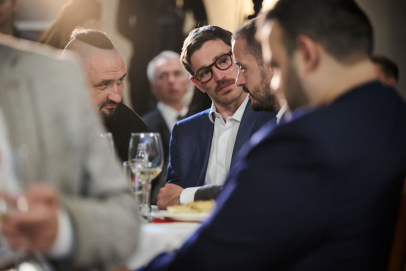
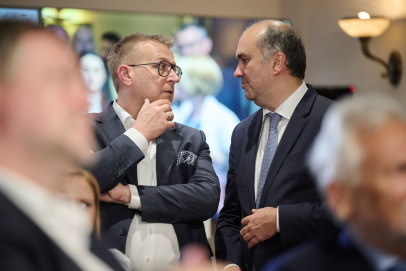
The night begins in a hip white Kiev bar with no right angles, proceeds via minibus through the snow-dusted streets to a 19th-century theatre and ends raucously in the Ukrainian capital’s most exclusive club. The guests are the global elite of the contemporary art world, out to witness the birth of the Future Generation Art Prize.
Sir Nicholas Serota, director of the Tate, calls it the first truly global art competition; Jeff Koons finds proof of art’s universal nature in the Brazilian winning entry; Damien Hirst says that he would have quit drinking younger had he won the $100,000 that comes with it; Takashi Murakami feels that the whole gathering is like an “art summit”; and Miuccia Prada just smiles at everyone from beneath a cossack hat.
Why are they all there, lending their collective weight to this upstart new award? How has the billionaire Ukrainian art lover Victor Pinchuk persuaded the world’s three most influential living artists, the directors of the Tate, the Guggenheim, the Museum of Modern Art in New York and the Musée National d’Art Moderne at the Centre Pompidou in Paris, Ms Prada, Sir Elton John and Eli Broad, the philanthropist-collector, to back his vision of a contest to find the world’s best young artist? Why did the directors of the past two Venice Biennales and two curators who loathe each other, and Ai Wei-Wei, the Chinese artist-activist whose porcelain sunflower seeds currently fill Tate Modern’s Turbine Hall agree to sit on the jury?
The art bubble was supposed to have burst when the world financial crisis hit in September 2008. Hirst’s £111 million Sotheby’s auction, beginning on the day that Lehman Brothers collapsed, was expected to mark the end of the party.
It didn’t. After a nervous 2009, confidence is back. The world record price for an artwork at auction has twice been broken this year.
The vaulting ambition of the biennial Future Generation Art Prize is on another level though. The prize is ostensibly for young artists. But it is really about pulling in older, globe-straddling cultural brand names that Mr Pinchuk thinks can put Ukraine on the world map. Hours before the ceremony last Friday, Mr Pinchuk said that his goals for the prize were “global, domestic and personal”.
Sitting in his office surrounded by the art of Hirst, Koons, Andreas Gursky (another board member), Salvador Dalí, Sam Taylor-Wood and Antony Gormley, Pinchuk is a warm host but with the build and watchfulness of a middleweight boxer.
Forbes magazine estimates his wealth at $3.1 billion and his London home is believed to be worth £80million. A former Soviet engineer, he made his money in steel pipes after the collapse of the USSR, married the daughter of the President of Ukraine and now owns six television stations and the country’s most popular newspaper. But he has forsaken political power for a different kind of influence, pursued through philanthropic projects and arts sponsorships with the likes of Paul McCartney, Sir Elton John, Steven Spielberg, George Soros and Bill Clinton.
Contemporary art is his greatest passion. He believes it can modernise Ukraine and change the world because, while Old Masters might cost a lot of money, “they don’t give you energy” like a Hirst or a Koons does. He also admits a hope that the prize will discover new artists for him to collect.
In fairness it is not only the money that has brought the art elite to Kiev. It is also about the arrival of an award that recognises, in Serota’s words “that the world has changed, very dramatically in the past few years”.
Most art prizes are, like the Turner prize, national contests. The Venice Biennale perhaps comes closest to being a full international exchange, but its structure is based on the pecking order of nations a hundred years ago.
More than 6,000 artists aged 35 or under applied for this competition from more than 125 countries. Two Britons, Simon Fujiwara and Emily Wardill, made the shortlist of 21 but, according to Serota, were never likely to win because the jury wanted an undiscovered talent from a country outside the traditional art powerhouses.
So instead the prize goes to Cinthia Marcelle, a little known 36-year-old video artist from Brazil who was TrAIN/Gasworks artist in residence at Camberwell College of Arts in South London last year. She looks radiantly happy and is one of the first on to the dancefloor afterwards, but she is not exactly the main focus of attention.
Alfred Pacquement, Director of the Musée National d’Art Moderne, remarks in wonder at one point that the event is unrecognisable from the kind of understated artworld occasions that curators of his generation grew up with.
“This is more about showbusiness or the movie industry than the art world [of the past]. Everything has changed, particularly the role of the market and of the media, who are much more interested.”
Nobody in the artworld has harnessed the market and the media like Hirst, Koons and Murakami, which is why the sight of them together for the first time has critics and gallery owners gawping in starstruck astonishment.
Hirst is all nervous, laddish energy, clowning around for photographers. Koons wears a glazed grin and looks, in his suit and tie, like the Wall Street broker that he once was. Murakami, with his hair in a topknot and a baggy suit, seems the most relaxed.
Ralf Schlüter, the veteran deputy editor of the German magazine Art sums up the collective delirium. “It’s unbelievable to see them in one room,” he says. “It’s like the Three Tenors of art. They should make an artwork.” Perhaps they just did: a unique 24-hour performance piece, staged in Kiev with a stellar cast, some variable art and an industrial quantity of Ukrainian vodka.