

Press about us
Modern Medicis flash their cash in Venice as the world of art goes into a new orbit
Author: Ben Hoyle
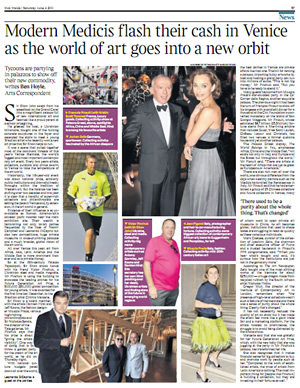 Sir Elton John swept from his speedboat on the Grand Canal into a magnificent palazzo full of new international art and beamed like a proud parent at a school prizegiving. He greeted his host, a Ukrainian billionaire, bought one of the hulking concrete sculptures in the foyer and ascended the stairs to meet a young Brazilian artist who recently won a new art prize that Sir Elton helps to run.
It was a scene that pulled together most of the dominant threads of this year's Venice Biennale, the world's biggest and most important contemporary art event. Every two years artists, collectors, curators and critics swarm to Venice to take the temperature of the art world. Historically, the 116-year-old event was about national pride, scholarly public institutions and dramatic breakthroughs within the tradition of Western art. But the balance has been shifting over two decades and this year it is clear that a handful of super-rich collectors and philanthropists are setting the pace in Venice and, by extension, in the art world in general. Evidence of their influence is as unavoidable as Roman Abramovich's colossal yacht moored near the main exhibition site. Their wealth is bankrolling not only lavish parties frequented by the likes of Naomi Campbell and Leonardo DiCaprio but also new competitions, huge private museums in once-crumbling palazzos and a much broader, global vision of the art world.
All over Venice this year, art from Africa, Asia, Latin America and the Middle East is more prominent than ever and so is private money.
So at the 16th-century Palazzo Papadopoli, Sir Elton shook hands with his friend Victor Pinchuk, a Ukrainian steel and media magnate. Mr Pinchuk is using the building to showcase the leading entries for his Future Generation Art Prize, a $100,000 (£61,000) global competition for young artists. It was awarded for the first time last December, to the Brazilian artist Cinthia Marcelle.
Sir Elton is a board member, with the artists Damien Hirst and Jeff Koons, the fashion designer Miuccia Prada, various high-rolling philanthropists and Sir Nicholas Serota, the director of the Tate galleries. Mr Pinchuk says that his prize is about "giving the artists visibility". One way of doing that is to throw a garden party for the cream of the art world, as he did on Thursday night.
With national culture budgets pared down all over the world, the best parties in Venice are private affairs like that one. The bill for renting a palazzo, importing bulky artworks by boat and hosting a grand party can run into millions of euros. "This is not big money," Mr Pinchuk said. "But you have to be ready to spend it."
Many guests had come from Miuccia Prada's star-studded party in the Ca' Corner della Regina, another exquisite palazzo. The previous night it had been the turn of Francois Pinault to show off his largesse with a candlelit dinner for a thousand at the Cini Foundation's converted monastery on the island of San Giorgio Maggiore. Mr Pinault, whose estimated $8.7 billion (£5.3 billion) fortune stems from a fine-living empire that includes Gucci, Yves Saint Lauren, Chateau Latour and Christie's, has filled two venues: a former customs house and yet another palazzo.
The Palazzo Grassi display, The World Belongs to You, emphasises Africa, China and the Middle East. "Art exists not only in Italy and Europe and the States but throughout the world," Mr Pianult said. "There are artists at the heart of Africa that are just as great as Europeans or Americans."
There are also rich men all over the world, one obvious difference from the days when wealthy patrons such as the Medicis bankrolled the Renaissance in Italy. Mr Pinault said that he had entertained a group of 25 Chinese collectors and future collectors in Venice, many of whom want to open private art museums in China. As art becomes global, institutions that used to shape tastes are struggling to react as quickly as these voracious individuals.
Mark Coetzee, curator of the collection of Joachim Zeitz, the chairman and chief executive officer of Puma and a trusted lieutenant in Pinault's PPR conglomerate, said: "When you hear what's bought and sold, it's curious how the institutions are just not in the game any more."
According to The Art Newspaper, Zeitz bought one of the most striking works at the biennale for about $250,000 — a huge dragon made from recycled rubbish by the South African artist Nicholas Hlobo.
Gregor Muir, the director of the Institute of Contemporary Art in London, remembers when "the presence of high-level collectors wasn't such a feature of the biennale and there was a sense of purity about the whole thing. Clearly that's changed."
It has not necessarily reduced the quality of art on show but it has made the event feel more like a giant trade fair and a marketing platform. For the artists hoisted to prominence, the struggle is to avoid being distracted by the whole circus.
Marcelle said that she was grateful for her Future Generation Art Prize, which, with the new baby that she was juggling at the party in Mr Pinchuk's palazzo, has transformed her life.
She also recognises that it makes financial sense for big collectors to buy and promote work by people such as her. "Compared to the work of established artists, the price of artists from Latin America is nothing. The most important thing for [people like Pinchuk] is building a collection, but they are investing in their fortune as well ."