

Press-releases
18.07.2006
YES has presented “Agenda 2020”, a plan of integration of Ukraine into the European Union
In Livadia Palace (Crimea, Ukraine), the third annual meeting of "Yalta European Strategy", an international network for Ukraine in EU, has accomplished its work. At its closing plenary session, the YES has presented "Agenda 2020", a plan for Ukraine's integration into the EU, which outlines a set of preparatory steps for Ukraine's entry to the EU.As it was noted by Marek Siwiec, member of the European Parliament and the YES Board, who was setting out this plan: the strategic document "Ukraine in the European Union: Agenda 2020" was compiled by the YES experts on the base of the opinion research conducted in the EU countries in 2002-2004, the expert surveys and the negotiations between the YES board and the EU leaders, namely, Jose Manuel Barroso, President of the European Commission, and Benita Berrero Waldner, European commissioner. The document was developed with consideration of Ukraine's political landscape and perspectives for its transformation, as well as the EU internal processes, in particular, the changes in the European Neighborhood Policy prognosticated for 2007, when Germany' will preside in the European Union.
The YES strategic document envisages the signing of the agreement on Ukraine's membership in the EU in 2019 at the latest, whereupon Ukraine will become a full-fledged member of the EU in 2020. The experts of this organization consider it should be a multistage work: the first stage (2006-2007) will require accomplishment of the Action Plan "Ukraine-European Union" signed in 2005, which will remain a framework for EU-Ukraine relations in 2006-2007.
In the course of this period Ukraine "must consolidate its political system on the basis of a sound constitutional reform and a proper equilibrium between the main state institutions", - the document states. Within the 2006-2007 actions, the experts recommend to implement the reforms of administrative, prosecution and judicial systems, to develop and implement the New National Anti-Corruption plan, adopting and implementing the law on the independence of state radio and television, adopting the laws ensuring the WTO accession and conclusion of the bilateral talks on this issue. The goal of the first stage is the EU approval of implementation of Ukraine's Action Plan with a view of signing a new agreement between Ukraine and EU.
The YES experts believe that it should be an association agreement modeled after agreements signed in the early 1990s by the recent Central European entrants to the European Union. The YES plans that the preparatory work on the framework of that agreement should start in mid 2006, so that the negotiations could be concluded in early 2007, in time for entry into force on 1 January 2008. "The basic tenant of the Association Agreement should be the further extension of the four freedoms - free flow of goods, capital, services and persons - in the EU-Ukraine relationship. The Association Agreement should amount to an establishment of a free trade area between the EU and Ukraine", - the document states. The experts stress that a separate chapter should concern issues of energy security.
The goal of this stage following the signing of the Association Agreement should be preparatory work for Ukraine's membership application to the EC. "It is clear that Ukraine will not be ready to become a candidate for membership in the next few years and the European Union will be far from ready to contemplate further rounds of enlargement until the next decade" - the document states. Therefore by 2010-2011 Ukraine should draft an EU Accession Strategy in which it would spell out the most important reforms it needs to undertake in order to become first a candidate and then a Member of the European Union. The delivery of the application should be accompanied by intensive diplomatic and image-building campaigns, raising awareness of the EU institutions and the Member States about the results of Ukrainian reforms and its European commitment. As the most optimal time for Ukraine's EU application, the document specifies the second half of 2011, during the presidency of Ukraine's strategic partner Poland in the Council of the European Union.
In the period following the application, the Ukrainian government must make every possible effort to demonstrate that its reforms have had a profound and irreversible effect. Additionally, one must convince the European Commission in the soonest (2012 at latest) examination of the foundations for Ukraine's EU membership. Following a positive decision of the Commission, the Council should take a decision on recognizing Ukraine's candidate status and opening accession negotiations during 2013.The opening of accession talks could then be scheduled for 2014. The experts emphasize that "Ukraine should then immediately establish a negotiating team for its talks on EU. It should be anchored well in the government structures to ensure smooth decision-making and proper implementation". The authors of this document suppose that it is likely that the final stage of accession negotiations will coincide with the conclusion of negotiations on the EU Financial Perspective 2021-2027, expected in the spring of 2019. Had the accession talks been successful, the Accession Treaty could be expected in 2019, and Ukraine's full-fledge membership - in January 2020.
While presenting the strategy "Agenda 2020", Marek Siwiec has pointed out that when the document is amended with an account of proposals of the YES third annual conference participants, it would be tabled to the President of European Commission Jose Manual Barroso. The YES also intends to submit it for discussion at the EU next summit in Helsinki, where the decision on alterations in the NEP could be taken.
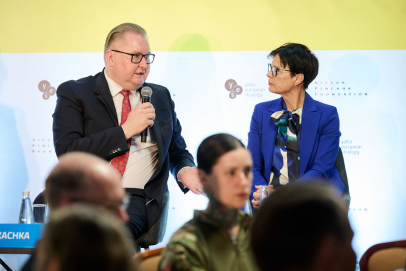
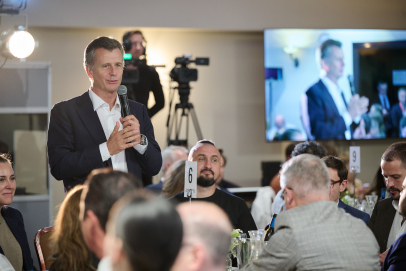
On 13-16 July YES hosted the Third Annual meeting in Kiev and Yalta where over 200 decision-makers, opinion leaders and diplomats from Europe and the USA participated, including members of parliaments and foreign ministers of EU states, members of European Parliament. Politicians and officials represented Great Britain, France, Germany, Poland, Ireland, Slovenia, Romania, Croatia, Russia and other countries.
Ukraine was represented by the chief of the Presidential administration Oleg Rybachuk, acting Prime Minister Yury Yehkanurov, Speaker of Ukrainian Parliament Alexander Moroz, acting Minister of Economy Arseniy Yatseniuk, reps of the Parliament's political forces. There were 6 plenary sessions and 4 workshops during the third annual meeting. The key topics for discussions were: Ukrainian views on the EU, today's format and perspectives of the European Neighborhood Policy, reforming of judicial system of Ukraine, Ukraine's public opinion on EU, economic reforms and problems of investment climate in Ukraine, lessons of the EU enlargement, interrelations of the European integration process and Euro-Atlantic contacts of Ukraine, new energy policy challenges. The key speakers of the meeting were Alexander Kwasniewski, ex-President of Poland; Stephen Byers, member of the parliament (Great Britain); Ivo Sander, prime minister (Croatia); Strobe Talbot, ex-State Secretary (USA), Pierre Lelouche, chairman of the NATO Parliamentary Assembly; Anders Aslund, senior fellow, Institute for International Economy (USA); Oleg Rybachuk, chief of the Presidential administration and others.
There was a workshop "The new Ukrainian political landscape" during this YES meeting, where reps of all political forces were participating: Dmitry Vydrin (Yulia Timoshenko Bloc), Ksenia Lyapina (Nasha Ukraina), Vasily Kiselev (Party of the Regions), Vitaly Shybko (Socialist Party), Vitaly Klichko, adviser to the President and Stanislav Belkovsky, politologist.
 (1) (1).png)